Choosing between Google Workspace (Gmail) and Microsoft 365 (Outlook) impacts your sales outreach performance.
Your platform decides how fast you can set up domains, how well your emails land in the inbox, and how easily your team can scale outreach.
In this blog, we’ll compare Google Workspace vs Microsoft 365 specifically for sales outreach, focusing on deliverability, setup time, scalability, and cost.
We’ll also show how Zapmail can simplify the entire process with pre-warmed Google and Microsoft inboxes ready to send from day one.
Google Workspace vs Microsoft 365: Quick Comparison
| Metric | Google Workspace (Gmail) | Microsoft 365 (Outlook) |
| Setup time | 10–15 minutes, simple and fast | 30–60 minutes, more steps required |
| Daily send limit | 2,000 emails per user (rolling 24 hours) | 10,000 recipients/day (2,000 external/day limit) |
| Recipients per message | Around 100 via SMTP relay | 500 recipients per message |
| Deliverability | Excellent, Gmail’s trusted IPs ensure higher inbox rates | High, strong protection but slower warm-up period |
| Ease of use | Clean, minimal, easy for new users | Slightly complex, better for IT-managed teams |
| Security & compliance | Built-in SPF, DKIM, and DMARC | Advanced encryption and enterprise compliance (GDPR, HIPAA) |
| Pricing | Starts at $6/user/month | Starts at $6/user/month |
| Best for | Startups and SMBs focusing on quick outreach | Enterprises with larger teams and IT oversight |
1. Deliverability: Who Lands in the Inbox More Often?
Both Google Workspace (Gmail) and Microsoft 365 (Outlook) have strong deliverability frameworks, but they differ in how they manage IP reputation, authentication, and anti-spam systems.
Here’s how they compare:
| Feature | Google Workspace (Gmail) | Microsoft 365 (Outlook) |
| Deliverability rate | High, Gmail’s IP pools are rarely blacklisted and trusted by most ISPs. | High, Microsoft’s global IP network maintains good sender reputation. |
| Email authentication | Fully supports SPF, DKIM, and DMARC with simple setup via Admin Console. | Fully supports SPF, DKIM, and DMARC with advanced policy controls. |
| Spam filtering | Google’s AI-based spam and phishing protection learns from billions of daily emails. | Microsoft’s Defender and AI-powered filters offer strong protection against spoofing. |
| IP reputation | Excellent, Gmail IPs consistently rank among the cleanest in global deliverability benchmarks. | Strong, but sometimes flagged for shared infrastructure in bulk mailing. |
Deliverability insights:
- Google Workspace → Easier to set up and maintain sender reputation. Ideal for smaller teams or new domains doing cold outreach.
- Microsoft 365 → Delivers strong inbox rates once warmed, especially for enterprise-level domains with DKIM/DMARC enforced.
If your priority is consistent inboxing and faster warm-up, Google Workspace has a slight edge for outreach teams.
For large organizations that already use Microsoft’s ecosystem and want deeper policy control, Microsoft 365 performs just as well, after initial ramp-up.
2. Scalability: Can It Grow With Your Team?
As your sales team grows, you’ll need to add new inboxes, manage permissions, and keep sending limits under control.
Your email setup should handle growth without technical issues or deliverability drops.
Here’s how Google Workspace and Microsoft 365 compare in terms of scalability:
| Scalability Factor | Google Workspace (Gmail) | Microsoft 365 (Outlook) |
| User management | Simple Admin Console, add or remove users in a few clicks. | Centralized Admin Center with advanced roles and controls. |
| Team size support | Great for small to medium teams; enterprise plans support unlimited users. | Built for large organizations; handles thousands of users easily. |
| Sending capacity | 2,000 emails per user per day. | 10,000 recipients per day (with sub-limit for external emails). |
| Account provisioning | Fast setup, each new account can go live in minutes. | Slightly slower setup, requires more admin configuration. |
| Domain flexibility | Easy to connect multiple domains for different campaigns. | Supports multiple domains but needs IT assistance for configuration. |
Scalability insights:
- Google Workspace → Best for startups and growing teams who want to quickly add new senders and manage everything without IT help.
- Microsoft 365 → Perfect for larger companies with complex hierarchies or compliance requirements that need advanced admin control.
3. Ease of Setup: How Quickly Can You Start Outreach?
When you’re setting up sales outreach, every minute counts.
The faster you can configure domains, add users, and verify authentication records (SPF, DKIM, DMARC), the sooner your team can start sending safely.
Both Google Workspace and Microsoft 365 make it possible to set up professional email hosting quickly, but there’s a noticeable difference in how simple the process is.
Here’s the comparison:
| Setup Factor | Google Workspace (Gmail) | Microsoft 365 (Outlook) |
| Setup time | Usually 10–15 minutes, simple domain verification and MX record update. | Takes around 30–60 minutes, as DNS setup and Exchange configuration require more steps. |
| Admin panel usability | Simple interface, ideal for non-technical users. | More advanced with additional controls, better suited for IT admins. |
| DNS configuration | Guided instructions for SPF, DKIM, and DMARC directly in Admin Console. | Manual setup in Exchange Admin Center; DKIM and DMARC require extra steps. |
| Adding users | Quick, can add or remove users instantly in the Admin Console. | Slightly slower, requires assigning roles and licenses individually. |
| Learning curve | Very low, beginners can set it up without IT support. | Moderate, requires basic IT knowledge for configuration. |
Setup Insights:
- Google Workspace → Best for sales teams or agencies that need to get started quickly without technical setup.
- Microsoft 365 → Better for larger companies that already use Microsoft tools and have dedicated IT staff to handle configurations.
4. Which One Has Better Automation & Workflow Integration?
When your sales outreach grows, automation becomes essential.
From sending follow-ups automatically to syncing email data with your CRM, your email platform should easily connect with the rest of your sales stack.
Both Google Workspace (Gmail) and Microsoft 365 (Outlook) support automation, but they work best with different ecosystems.
Here’s how they compare:
| Automation & Workflow Factor | Google Workspace (Gmail) | Microsoft 365 (Outlook) |
| Automation tools | Works seamlessly with Zapier, Make (Integromat), and Google Apps Script to automate outreach tasks. | Uses Power Automate (formerly Microsoft Flow) for deep workflow automation across Microsoft apps. |
| CRM integrations | Connects easily with HubSpot, Pipedrive, Apollo, Copper, and Zoho CRM. | Natively integrates with Dynamics 365, Salesforce, Zoho, and LinkedIn Sales Navigator. |
| Calendar and task automation | Gmail integrates with Google Calendar and Tasks. | Outlook integrates directly with Microsoft Teams, Planner, and To Do for task automation. |
| Template and follow-up automation | Add-ons like Gmail Templates, Yet Another Mail Merge, and Gmelius simplify automated follow-ups. | Outlook supports Quick Parts, Rules, and Power Automate flows for recurring outreach. |
| Reporting & analytics | Basic insights through the Google Workspace dashboard and third-party CRMs. | Advanced analytics through Microsoft Power BI and Dynamics 365 Insights. |
| Third-party compatibility | Extremely wide, works with 5,000+ apps via Zapier and Google APIs. | Best for businesses that already rely on Microsoft ecosystem tools. |
If you use tools like HubSpot, Apollo, or Pipedrive, Google Workspace gives you faster plug-and-play automation.
If your company runs entirely on Microsoft tools, Outlook with Power Automate offers deeper, centralized workflow control.
5. Security & Compliance: How Do Google Workspace and Microsoft 365 Differ?
When you’re doing sales outreach, you’re handling sensitive data, like prospect emails, company domains, and contact details.
That’s why security and compliance matter just as much as deliverability or automation.
Both Google Workspace and Microsoft 365 (Outlook) offer enterprise-grade security, but they differ in how deeply you can customize controls, manage compliance, and monitor user activity.
Here’s how they compare:
| Security & Compliance Factor | Google Workspace (Gmail) | Microsoft 365 (Outlook) |
| Encryption | Uses TLS encryption by default for emails in transit; supports S/MIME for higher security. | Uses TLS and S/MIME by default; offers Information Rights Management (IRM) for advanced control. |
| Email authentication | Fully supports SPF, DKIM, and DMARC, configured via Google Admin Console. | Fully supports SPF, DKIM, and DMARC, set up through Exchange Admin Center. |
| Threat detection | Built-in AI-based phishing and malware protection, powered by Google’s Safe Browsing. | Uses Microsoft Defender for Office 365, with AI-driven protection, sandboxing, and real-time threat monitoring. |
| Access control | Simple user- and group-based permissions through Admin Console. | Advanced role-based access controls, multi-factor authentication, and conditional access policies. |
| Data compliance | Meets major frameworks: GDPR, CCPA, HIPAA (on Enterprise plans), ISO/IEC 27018. | Meets all major standards: GDPR, HIPAA, FedRAMP, SOC 1/2, ISO/IEC 27018, and more. |
Both are highly secure.
If your goal is simplicity and quick setup, Google Workspace is perfect.
If your outreach operations require advanced compliance (HIPAA, FedRAMP, SOC), Microsoft 365 offers more control and certifications.
Pricing Comparison: Google Workspace vs Microsoft 365
When you’re choosing an email platform for sales outreach, cost matters.
Here’s how the monthly pricing compares in USD for the base business-plans of each platform:
| Platform | Plan | Cost per user/month (USD) | What it includes |
| Google Workspace | Business Starter (Flexible) | $8.40 | Custom business email, 30 GB storage/user, basic tools & security. |
| Google Workspace | Business Standard (Flexible) | $16.80 | All Starter features + 2 TB storage/user, more collaboration tools. |
| Microsoft 365 | Business Basic | $6.00 | Business-class email, 1 TB OneDrive, web/mobile Office apps. |
| Microsoft 365 | Business Standard | $12.50 | Full desktop Office apps + Business Basic features. |
Suppose your sales team has 15 users. Here’s how the monthly cost looks:
- Google Workspace Business Starter: $8.40 × 15 = $126/month
- Microsoft 365 Business Basic: $6 × 15 = $90/month
So, in practice, Google Workspace costs about $36 more per month for the same number of inboxes.
The difference isn’t massive, but it adds up as your team grows.
That’s why most small outreach teams pick Microsoft 365 when they want to save on licenses, while others stick with Google Workspace for its cleaner setup, Gmail interface, and faster onboarding.
In short, Microsoft 365 wins slightly on cost, but Google Workspace often wins on usability and simplicity.
A Faster and More Affordable Alternative: Zapmail
With Google Workspace or Microsoft 365, you pay around $6–$8.40 per user every month, and that only covers the inbox.
To make those inboxes usable for cold outreach, you’ll still need to:
- Buy and connect new domains.
- Set up SPF, DKIM, and DMARC records.
- Spend 2–3 weeks warming up each mailbox.
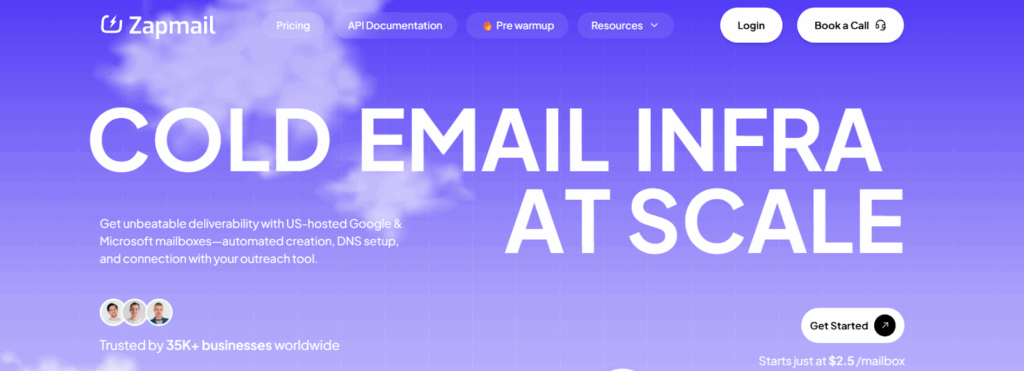
That means your real cost is much higher, and your campaigns are delayed before they even begin.Zapmail is built on the same trusted Google and Microsoft infrastructure, but gives you pre-warmed, deliverability-optimized mailboxes that are ready to send from day one, starting at just $2.5 per mailbox.
| Feature | Google Workspace / Microsoft 365 | Zapmail |
| Monthly Cost | $6–$8.40 per mailbox | Starts at $2.5 per mailbox |
| Setup Time | 30–60 mins (manual DNS, warmup) | <10 mins (fully automated) |
| DNS & Authentication | Manual SPF, DKIM, DMARC setup | Automatically configured for every mailbox |
| Warmup Time | 2–3 weeks before outreach | 0 days — pre-warmed for 12+ weeks |
| Deliverability | Depends on sender reputation | High — clean US/EU IPs + verified domains |
| Domain Management | Separate purchase & manual linking | Buy, connect, and manage directly inside Zapmail |
| Tool Integration | Manual connection | 1-click export to 50+ tools (Smartlead, Instantly, Lemlist, Reply) |
| Ban Risk | Moderate (shared domains/IPs) | Very Low — isolated workspaces |
With Zapmail, you still use official Google and Microsoft 365 mailboxes, just without the technical hassle.
Each domain runs on a clean US/EU IP, all records are fully authenticated, and every inbox is pre-warmed and ready to connect with your outreach platform.
That means you can skip DNS setup, skip the warm-up wait, and skip paying for extra warm-up tools, all while keeping your deliverability strong and consistent.
Google Workspace vs Microsoft 365: Which One You Should Pick for Sales Outreach
Both Google Workspace and Microsoft 365 are solid choices if your goal is to build a professional, reliable email setup for sales outreach.
Google Workspace is easier to set up and great for smaller teams, while Microsoft 365 offers stronger admin control and compliance for larger organizations.
But when it comes to cold email outreach, both platforms still require extra work, from domain setup and DNS authentication to mailbox warm-up and deliverability management.
That’s where most sales teams lose time before their first campaign even starts.
If you want to skip all that and start sending right away, Zapmail is a much faster and more affordable choice.
It gives you official Google and Microsoft mailboxes that are already pre-warmed, authenticated, and deliverability-optimized, so you can launch campaigns instantly and focus on results, not setup.
Start sending from day one with pre-warmed Google and Microsoft mailboxes, fully ready for outreach, starting at just $2.5 per mailbox.
Frequently Asked Questions
1. Can I use Google Workspace or Microsoft 365 for cold email outreach?
Yes, you can. But both platforms are designed for business communication, not large-scale outreach. You’ll still need to buy domains, warm up mailboxes, and manage deliverability manually.
2. Which platform is easier to set up for sales teams?
Google Workspace is easier to set up. It takes about 10–15 minutes to configure your domain and inboxes, while Microsoft 365 setup usually takes longer due to additional admin controls.
3. Which offers better deliverability, Google Workspace or Microsoft 365?
Both offer high deliverability since they’re trusted providers. However, deliverability depends more on domain reputation, DNS setup, and warm-up, not just the platform.
4. How much do Google Workspace and Microsoft 365 cost per user?
Google Workspace starts at $8.40 per user/month, while Microsoft 365 Business Basic starts at $6 per user/month. Both have higher plans with more storage and advanced features.
5. Do these platforms include mailbox warm-up?
No. Neither Google Workspace nor Microsoft 365 includes mailbox warm-up. You’ll need a separate warm-up tool or pre-warmed mailboxes to improve inbox placement.