Email salutations in 2026 have evolved into a critical part of professional communication, especially in cold outreach. With inboxes flooded daily and spam filters becoming more sophisticated, the way you open an email can determine whether it gets read or ignored. Here’s what you need to know:
- What is an email salutation? It’s the opening line of your email (e.g., "Hi Sarah" or "Dear Mr. Johnson") that sets the tone for your message.
- Why does it matter? A personalized salutation shows effort, improves engagement, and helps your email avoid spam filters.
- How has it changed? AI now helps craft tailored salutations by analyzing recipient data, making generic greetings like "To Whom It May Concern" obsolete.
- What works best? Use formal greetings for traditional industries (e.g., "Dear Mr. Smith"), casual ones for tech or startups (e.g., "Hi Alex"), and group salutations for teams (e.g., "Hi Team").
- Tools like Zapmail streamline personalization at scale, improving deliverability and engagement in large campaigns.
The key takeaway? Personalization is no longer optional – it’s essential for standing out in crowded inboxes.
What Are Email Salutations and Why Do They Matter?
What Email Salutations Are
An email salutation is the opening greeting that starts your message – think of it as your first impression. It’s that initial line, like "Hi Sarah" or "Dear Mr. Johnson", that sets the tone for what follows. It might seem like a small detail, but it plays a big role in shaping how the recipient perceives you before diving into the main content.
In many ways, the salutation acts as a "mood ring" for your email. It gives an immediate sense of whether your approach is formal, casual, or somewhere in between. And with the rise of AI-generated communication in 2026, a thoughtful salutation can signal genuine human effort.
Let’s dive into why these greetings hold so much weight in professional emails.
Why Salutations Matter in Professional Emails
In a world where inboxes are flooded with messages, a well-thought-out salutation can make all the difference. Emails that begin with a personalized greeting are far more likely to be read all the way through compared to those that skip straight to the pitch. Why? Because addressing someone by name shows you’ve put in the effort to connect with them personally.
"Your email salutation is the digital handshake. It’s the first flicker of personality your prospect sees." – Pierre Dondin, Content Lead, Topo.io
The impact of a good salutation isn’t just theoretical – it’s backed by data. In June 2023, Gabriel Frasconi, Head of Sales at Zendesk, boosted open rates from 35% to 75% by using personalized greetings, which also doubled the number of meetings booked. Similarly, Anna from Convelio achieved an 88% open rate by pairing polite greetings with tailored references to each recipient’s business.
Your choice of salutation also demonstrates your understanding of the recipient’s industry and role. For example, professionals in finance or law tend to expect "Dear Mr./Ms. [Last Name]", while a tech startup founder might prefer "Hi [First Name]". On the flip side, generic openers like "To Whom It May Concern" are often seen as "the ultimate white flag of lazy outreach", and they rarely make it past the delete button.
How Salutations Affect Email Deliverability
Personalized salutations don’t just help with engagement – they can also improve the chances of your email landing in the recipient’s inbox. When you send the same generic greeting across thousands of emails, spam filters take notice. Repetitive and impersonal greetings can trigger these filters, harming your deliverability rates.
To avoid this, tools like Zapmail use AI to create personalized salutations at scale. By tailoring greetings to match recipient data, these tools ensure that each email feels unique while keeping spam filters at bay. This approach signals to email providers that your messages are legitimate and thoughtfully crafted – not mass-produced spam.
| Salutation Type | Example | Best Use Case |
|---|---|---|
| Formal | Dear Mr./Ms. [Last Name] | Senior professionals in traditional industries |
| Semi-Formal | Hello [First Name] | A balanced approach for initial outreach |
| Casual | Hi [First Name] | Ideal for tech, B2B, or familiar contacts |
| Group | Hi Team / Hi Everyone | For addressing departments or multiple recipients |
| Neutral | Greetings | When a name isn’t available despite research |
Choosing the right salutation not only sets the tone for your email but also plays a role in ensuring it gets seen and read. This balance between personalization and professionalism is key to effective email communication.
Business Email Etiquette | Salutation in an Email | Email Writing | Tutorialspoint
How Email Salutations Changed by 2026
By 2026, email salutations have undergone a major transformation, moving away from the traditional "Dear Sir or Madam" to embrace smarter, more tailored greetings. This shift reflects advancements in technology, evolving social norms, and changing expectations in professional communication.
AI now plays a pivotal role in crafting these greetings, analyzing recipient personas, industry standards, and intent signals to strike the right tone. Machine learning models take into account detailed lead profiles to balance formality with a casual touch. In other words, the era of generic, one-size-fits-all greetings is long gone.
Personalization has reached a whole new level. It’s no longer just about inserting a recipient’s first name. AI platforms now incorporate details like recent LinkedIn activity, articles authored by the recipient, or significant company achievements. This sets a higher bar for outreach, making emails feel more thoughtful and relevant.
"The strategic choice of a greeting is your first, and best, chance to signal that a real human is on the other side of the screen." – Pierre Dondin, Content, Topo.io
At the same time, a broader cultural shift toward casual communication has made greetings like "Hi" and "Hey" more common, replacing the stiff and formal openers of the past. Interestingly, while only about 5% of senders personalize every email, those who do see results that are 2–3 times better. In an inbox crowded with AI-generated messages, a thoughtful salutation is now a key indicator of genuine human effort.
To ensure deliverability and avoid spam filters, AI platforms have also adopted techniques like spintax, which rotates greetings (e.g., "Hi", "Hello", "Greetings") to make each email feel distinct. This not only protects sender reputation but also ensures that mass outreach still feels personal and unique.
Types of Email Salutations Used in 2026
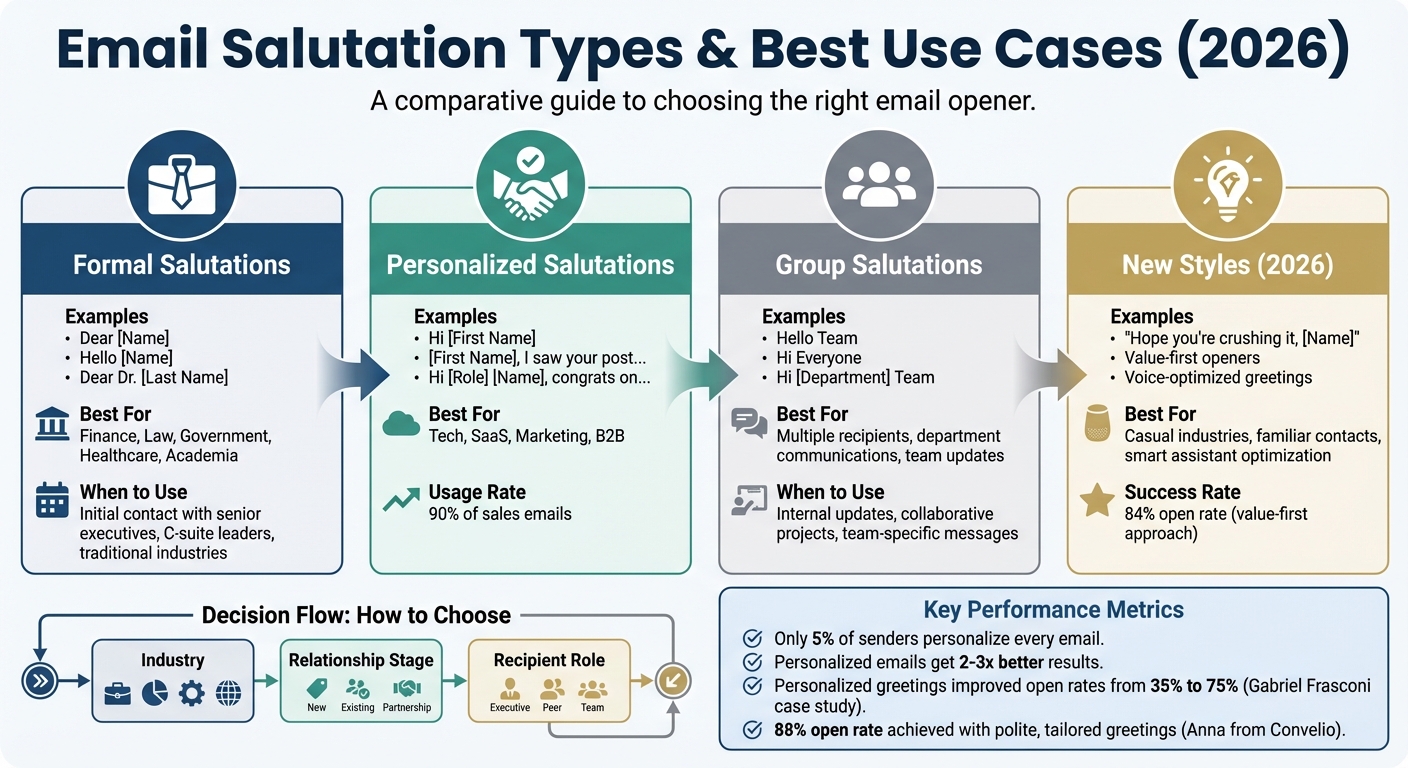
Email Salutation Types and Best Use Cases for 2026
By 2026, email salutations have evolved to reflect diverse professional environments and communication preferences. Picking the right salutation can shape your email’s first impression, and professionals now lean on four key categories. Each serves a purpose, tailored to industry norms, the stage of a relationship, and the recipient’s context.
Formal Salutations
When it comes to traditional industries like finance, law, or government, "Dear [Name]" remains the go-to. It conveys respect and professionalism, especially for initial contact with senior executives or C-suite leaders.
For a slightly less rigid tone, "Hello [Name]" strikes a balance between formal and approachable. This works well when you’re unsure of the recipient’s preferred communication style.
In fields like healthcare and academia, titles hold weight. Using "Dear Dr. [Last Name]" or similar formal titles adds credibility and aligns with expectations in these sectors.
Personalized Salutations
"Hi [First Name]" has become a staple in modern B2B communication, used in a staggering 90% of sales emails. It’s professional yet friendly, making it highly effective for industries like tech, SaaS, and marketing.
Personalization goes beyond just using a name. Context-driven openings can make a big difference. For instance, starting with "[First Name], I saw your post on LinkedIn about…" or "Hi [Role] [Name], congrats on the recent funding round" adds relevance and engagement. A great example comes from June 2023, when Daria achieved an impressive 85% reply rate by beginning her email with: "I saw you voted on my LinkedIn poll about link-building and thought we need to connect".
Group Salutations
For emails sent to multiple recipients, "Hello Team" or "Hi Everyone" keeps things inclusive and straightforward. When addressing a specific department and individual names aren’t available, options like "Hi [Department] Team" – such as "Hi Marketing Team" – strike a balance between personal and collective communication. These are particularly effective for internal updates, collaborative projects, or team-specific messages.
New Salutation Styles in 2026
Emerging trends in 2026 include AI-generated salutations designed to stand out in crowded inboxes. For example, pattern interrupt salutations like "Hope you’re crushing it, [Name]" or starting directly with a value proposition are gaining traction in casual industries or with familiar contacts.
"How about if I try to bring you customers over the next seven days, completely free?"
This value-first opener, used by Romain Carpentier, led to an 84% open rate for his prospecting software outreach.
Another innovation is voice-optimized greetings, crafted to sound natural when read aloud by smart assistants. These use conversational phrasing to align with the growing trend of listening to emails rather than reading them.
The trick with these newer styles is knowing your audience. A casual, creative salutation might work wonders in tech but could backfire in more conservative industries like finance. If you’re unsure, mirroring the recipient’s tone and style, as seen in their LinkedIn posts or past emails, is often a safe bet.
sbb-itb-36f7bf9
How Email Salutations Work in Cold Email Campaigns
In cold email outreach, your salutation serves as a digital handshake, creating a first impression within just a few seconds. A thoughtfully crafted salutation shows there’s an actual person behind the email, not just another automated message.
Matching Salutations with Subject Lines
Your subject line sets the tone, and your salutation needs to match it perfectly. For instance, if your subject line says, "Quick question about your Q1 goals", but your greeting feels generic or off, you risk losing credibility right away. Maintaining a consistent tone is crucial. A formal subject line paired with a casual "Hey [Name]" can feel jarring, just as a casual subject line followed by "Dear Mr. [Last Name]" might seem overly stiff.
Different industries have different expectations. For example:
- Tech and SaaS sectors: "Hi" or "Hey" often works best.
- Finance, law, and government fields: "Dear" or "Hello" is generally preferred.
Experimenting with combinations – like pairing a question-based subject line with "Hi [Name]" or a formal subject line with "Dear [Name]" – can help pinpoint what resonates most with your audience. A useful tactic is the "information scent" approach: your subject line grabs attention, and your salutation, along with the opening line, immediately convinces the recipient that the email is worth their time. This alignment lays the groundwork for personalization, which plays a big role in improving email deliverability.
How Personalization Improves Deliverability
Personalized salutations do more than just engage your audience – they safeguard your sender reputation. Spam filters look for repetitive patterns, so if every email starts with the same generic greeting, it might be flagged as spam. Ziemek Bućko, Cold Email Evangelist at Hunter.io, explains:
"One essential characteristic of spam is that every email is the same, no matter who the recipient is. If there are slight differences in your emails, your campaign will look less spammy to email providers."
Using spin syntax to vary greetings – like rotating between "Hi", "Hello", and "Greetings" – adds diversity to your emails and helps you avoid spam filters. This approach can significantly improve inbox placement rates, with personalized emails achieving rates above 80%, compared to 40–60% for generic ones. Positive engagement signals, such as opens, clicks, and replies, further bolster your sender reputation.
The impact of personalization can be substantial. For example, during the COVID-19 pandemic, Lifesize teamed up with Adobe to personalize outreach for 300,000 leads. The results? A 57% increase in open rates, an 82% boost in response rates, and a 31% year-over-year revenue growth. These strategies highlight how personalization can elevate email campaigns to the next level.
Using Zapmail for Large-Scale Outreach
When it comes to scaling personalized outreach, tools like Zapmail make the process efficient and effective. Zapmail simplifies large-scale campaigns by offering pre-warmed Google and Microsoft mailboxes – already optimized for deliverability – so you don’t have to deal with the challenges of a cold domain[zapmail.ai].
Its API takes salutation customization to the next level by automatically pulling recipient data, like first names, job titles, or recent company news, to create tailored greetings. Zapmail also allows bulk customization for sender profiles, enabling you to configure hundreds of mailboxes with unique names and signatures to avoid spam triggers.
With integrations for over 50 outreach tools, Zapmail fits seamlessly into your workflow, ensuring consistent personalization. For agencies juggling multiple campaigns, its workspace-level domain isolation keeps each client’s infrastructure separate, protecting your overall sender reputation. Pricing starts at $39/month for 10 mailboxes on the Starter plan, scaling up to $299/month for 100 mailboxes with API access on the Pro plan[zapmail.ai].
How to Create Better Email Salutations with Zapmail
The art of crafting email salutations in 2026 has become a mix of technical precision and personal touch. To make your outreach effective, you need both a solid technical foundation and smart automation. Zapmail takes care of the technical side, so you can focus on building genuine connections.
Using AI Tools for Salutations
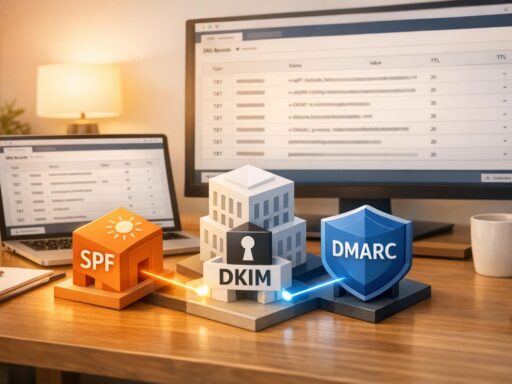
Creating the perfect salutation isn’t just about the words you choose – it’s also about ensuring your email is technically sound. Without proper domain authentication, even the most thoughtful greeting can fall flat. Zapmail automates critical protocols like SPF, DKIM, DMARC, and MX records, so your emails are verified and ready to go from day one.
Zapmail also simplifies email identity with its Smart Mailbox Namer tool. Instead of clunky email addresses like "sales.team.123@yourdomain.com", you’ll have clean, professional handles that match your brand tone. For an added personal touch, the Persona Snapshots feature generates AI-powered profile images that you can include in your email signature, making your outreach feel more human. As highlighted in Zapmail’s Help Center:
"With Zapmail, domain setup, DNS, and authentication are handled automatically – so your foundation is ready from day one."
Need help crafting the perfect salutation? The AI Email Generator can whip up tailored greetings and sign-offs in seconds, adjusting its tone to fit your industry and audience.
With these tools, Zapmail ensures personalization doesn’t just happen – it happens at scale.
Personalizing Emails at Scale
Zapmail integrates seamlessly with over 50 outreach platforms, making it easy to use merge tags like {{first_name}} and {{company_name}} across thousands of emails. Its Workspace-Level Isolation feature assigns one domain per workspace, helping protect your sender reputation when managing multiple campaigns.
Start small, sending 10–20 emails per mailbox daily, and scale up gradually. Pre-warmed mailboxes let you hit the ground running without waiting the usual two weeks to ramp up. Plus, fallback values like {{firstName|there}} keep your greetings natural, even when some prospect data is missing.
Mohan Muthoo, Founder of Spring Drive, emphasizes the importance of this infrastructure:
"One domain per workspace gives us absolute risk control and this is the best way to segment a large infra."
For international campaigns, tailor your salutations to fit local customs. Use formal titles in Germany and France, "-san" in Japan, and semi-formal greetings like "Hi [First Name]" for U.S.-based tech companies.
Once you’ve nailed your email strategy, the next step is choosing the right Zapmail plan to match your outreach needs.
Choosing the Right Zapmail Plan
Zapmail offers flexible plans to suit different outreach volumes. Here’s a quick breakdown:
- Starter Plan: $39/month for 10 Google mailboxes, perfect for freelancers or small teams. Additional mailboxes cost $3.50 each.
- Growth Plan: $99/month for 30 mailboxes, ideal for mid-sized agencies. The cost per extra mailbox drops to $3.25.
- Pro Plan: $299/month for 100 mailboxes, API access, and priority support, designed for large-scale operations. Additional mailboxes are $3.00 each.
| Plan | Monthly Price | Mailboxes Included | Best For | Additional Mailbox Cost |
|---|---|---|---|---|
| Starter | $39 | 10 | Freelancers & small teams | $3.50 |
| Growth | $99 | 30 | Mid-sized agencies | $3.25 |
| Pro | $299 | 100 | Large-scale operations | $3.00 |
All plans include automated DNS setup, U.S./EU IP accounts, and integrations with major outreach tools. Plus, setup is lightning-fast – just 10 minutes compared to the usual 48-hour wait.
Conclusion
In 2026, email salutations have evolved far beyond simple formalities – they’ve become strategic elements that can determine whether your message gets read or ignored. The shift from generic greetings to highly personalized openers reveals a broader reality: in an inbox overflowing with AI-generated content, adding a human touch makes all the difference.
This change highlights a deeper transformation in cold email strategies. As Sujan Patel, Founder of Mailshake, explains:
"The future of cold email isn’t volume. It’s strategy."
And that strategy begins with your salutation. Addressing tech prospects with a casual "Hi" or opting for "Dear" when reaching out to more traditional industries demonstrates respect and can lead to reply rates that are 2–3 times higher.
Zapmail supports this personalization by leveraging automated DNS, AI-powered naming tools, and seamless integrations – giving you the freedom to focus on crafting authentic, human-centered greetings.
Looking at these trends, it’s clear that casual communication is becoming the norm, but hyper-personalization is now the minimum standard for cutting through inbox clutter. The tools that combine AI-driven efficiency with human intuition are the ones that will stand out. Ultimately, your salutation is more than just an opener; it’s the gateway to building a genuine connection.
Start with the right greeting, and pair it with the right tools to turn cold outreach into meaningful conversations.
FAQs
How is AI improving email salutations in 2026?
AI has reshaped the way we approach email salutations, turning them into highly tailored and engaging openers. By tapping into data like a recipient’s name, job title, LinkedIn activity, or previous interactions, AI tools create greetings that feel personal and relevant. This level of customization doesn’t just make emails more appealing – it also leads to higher open and reply rates, as recipients are more inclined to engage with messages that feel directly connected to them.
Beyond just personalization, AI takes it a step further by analyzing engagement metrics to refine salutations over time. It can tweak elements like tone, formality, and punctuation, even weaving in subtle hints of your brand’s voice to make each email feel polished and professional. On top of that, these tools ensure your emails are optimized for deliverability, helping them stand out in crowded inboxes while staying on the right side of spam filters – all in just seconds.
Why are personalized email salutations important for improving email deliverability?
Personalized email greetings play a crucial role in boosting deliverability by grabbing attention and creating a sense of connection with recipients. Research indicates that 87% of people favor emails that address them by name, and nearly half base their decision to open an email on the greeting alone.
In contrast, generic salutations often come across as impersonal, increasing the chances of your email being overlooked or even marked as spam. By crafting tailored greetings, you not only improve open rates but also encourage better engagement, making your email efforts more impactful and polished.
What are the best practices for using email salutations across different industries?
The secret to nailing email salutations lies in aligning the tone and level of formality with what the recipient expects. Always kick things off with the recipient’s name or their title and name – it’s a simple way to make the email feel more personal, which can help establish a connection and boost engagement. Steer clear of generic options like “To Whom It May Concern” unless you have no other choice.
If you’re writing to someone in a formal field like law, medicine, or government, go with respectful openings such as “Dear Dr. Smith” or “Dear Mr. Jones”. In more relaxed industries like technology or marketing, something like “Hi Alex” or “Hello Team” feels more appropriate. When addressing academics, stick with formal titles like “Dear Professor Lee”. For customer-focused sectors like retail or hospitality, a friendly “Hey there” or “Good morning” fits the tone of the industry.
No matter the industry, double-check that you’ve spelled the recipient’s name correctly, match the formality to their role, and keep your greeting short and to the point. If you’re unsure, you can’t go wrong with a straightforward “Dear [First Name]”, which strikes a balance between professional and approachable.