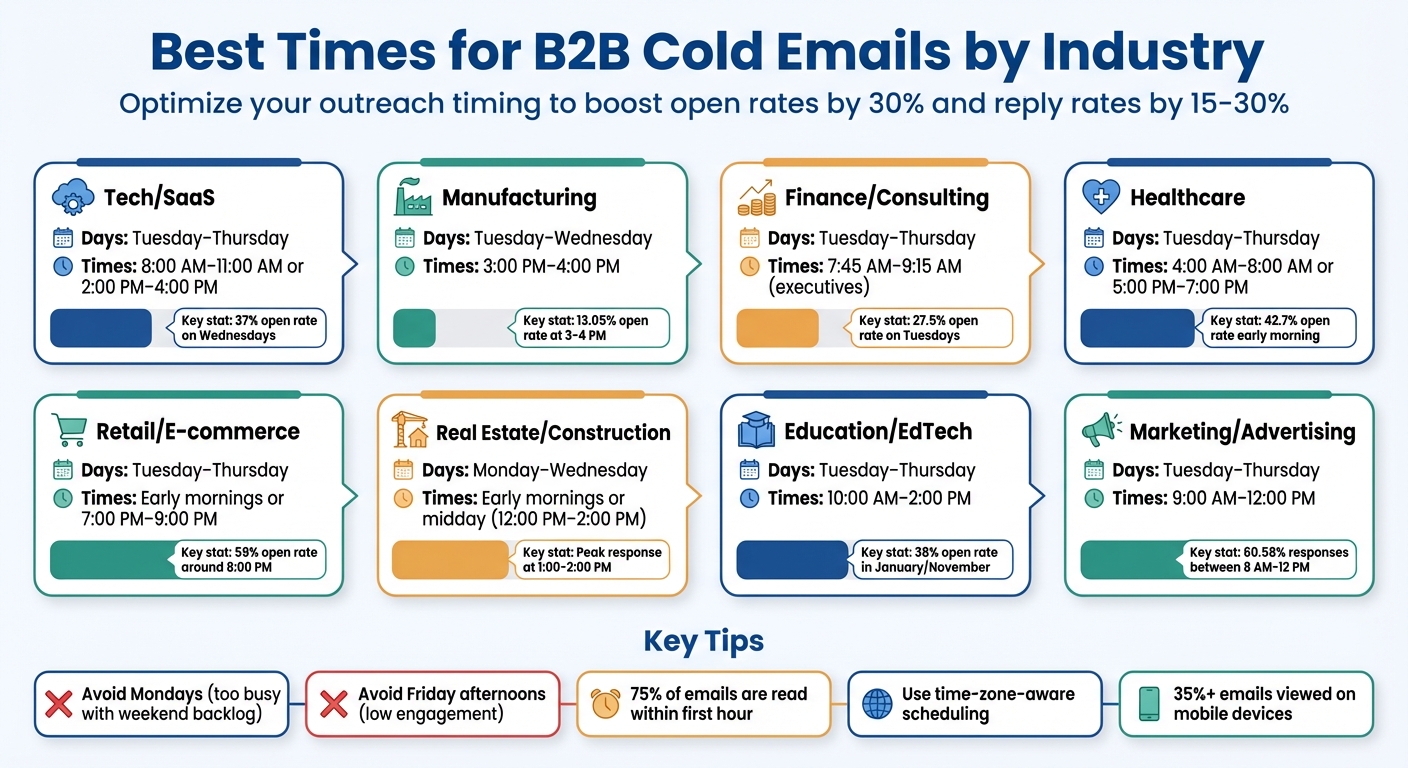
Timing can make or break your B2B cold email strategy. Emails sent at the right time can boost open rates by up to 30% and reply rates by 15%-30%. Here’s a quick summary of the best days and times to send emails across key industries:
- Tech/SaaS: Tuesday–Thursday, 8:00 AM–11:00 AM or 2:00 PM–4:00 PM.
- Manufacturing: Tuesday–Wednesday, 3:00 PM–4:00 PM.
- Finance/Consulting: Tuesday–Thursday, early morning (7:45 AM–9:15 AM) for executives.
- Healthcare: Tuesday–Thursday, 4:00 AM–8:00 AM or 5:00 PM–7:00 PM.
- Retail/E-commerce: Tuesday–Thursday, early mornings or evenings (7:00 PM–9:00 PM).
- Real Estate/Construction: Monday–Wednesday, early mornings or midday.
- Education/EdTech: Tuesday–Thursday, 10:00 AM–2:00 PM.
- Marketing/Advertising: Tuesday–Thursday, 9:00 AM–12:00 PM.
Key tips:
- Avoid Mondays (too busy) and Friday afternoons (low engagement).
- Use time-zone-aware scheduling to ensure your email lands at the recipient’s local time.
- Emails sent early in the morning or during quiet moments (e.g., evenings) often perform well.
Pro tip: 75% of emails are read within the first hour of delivery, so timing is critical. Tools like Zapmail can help with proper scheduling and deliverability to avoid spam filters.
Let’s dive into the specifics for each industry.
Best Times to Send B2B Cold Emails by Industry
1. Tech and SaaS Industry
Optimal Days of the Week for Cold Email Outreach
If you’re reaching out to professionals in the Tech and SaaS industry, aim for midweek. Tuesday through Thursday consistently delivers the best results, with Wednesday leading the pack. On average, emails sent on Wednesday see a 7.2% reply rate and a 37% open rate, while Tuesday boasts a solid 27.5% open rate.
Steer clear of Monday mornings. Why? The backlog from the weekend and early-week planning sessions leave little room for email attention. Antonio Gabric, Outreach Manager at Hunter.io, puts it bluntly:
"Mondays are the worst for sending emails… companies have meetings and weekly planning sessions, so they have limited focus on answering emails".
Fridays can also be tricky, especially in the afternoons. Many tech teams are busy wrapping up deployments or closing out their week. Timing matters – let’s dive into the best hours to send your emails.
Best Time of Day for High Open and Response Rates
For the best shot at engagement, aim to send emails between 8:00 AM and 11:00 AM. This window aligns with when professionals are reviewing their inboxes. To stand out even more, use non-standard times like 10:37 AM or 11:13 AM – this can help bypass email provider throttling.
Interestingly, emails sent earlier, between 4:00 AM and 8:00 AM, often land at the top of the inbox, achieving open rates as high as 42.7%. These early sends also drive about 20% of successful replies when recipients check their inboxes later in the morning.
Afternoons, specifically 2:00 PM to 4:00 PM, are another sweet spot. This period catches decision-makers during breaks from deep work. Evenings, from 8:00 PM to 11:00 PM, can also yield results, with a 6.52% reply rate. Late-night hours often provide a quieter moment for professionals to thoughtfully review emails.
Industry-Specific Factors Influencing Email Timing
Timing in the Tech and SaaS world isn’t just about the clock – it’s about understanding the rhythms of the industry. Developers often work in "heads-down" coding sessions, making them more likely to respond later in the day. Additionally, the rise of remote work and SaaS buyers’ focus on process improvement early in the week makes timezone-aware scheduling crucial. Sending emails to land at 9:00 AM in the recipient’s local time can increase engagement by 20%.
On average, cold emails in the SaaS industry see a 25.71% open rate. For targeting specific roles, timing is key: C-suite executives are most likely to engage before 9:15 AM, while VPs and Directors tend to respond between 10:15 AM and 11:45 AM.
2. Manufacturing and Industrial Sector
Optimal Days of the Week for Cold Email Outreach
When it comes to reaching out in the manufacturing world, Tuesday and Wednesday are your best bets. These mid-week days show consistently high engagement, with Tuesday boasting an 11.4% open rate and a 25.7% click-through rate. Wednesday isn’t far behind, with an 11.3% open rate and the highest click-to-open rate of the week at 26.3%.
On the flip side, avoid Mondays and Fridays. Mondays are chaotic, with professionals tackling weekend backlogs and planning for the week ahead. Fridays, meanwhile, see engagement nosedive as teams wrap up for the weekend. Open rates drop to 8.8%, and click-to-open rates shrink to 20.1%.
Best Time of Day for High Open and Response Rates
Timing is everything, especially in manufacturing. Sending emails between 8:00 AM and 9:00 AM is a bad idea – open rates during this hour slump to just 5.01%. Why? Most professionals are on the factory floor, not at their desks.
The sweet spot lies in the 2:00 PM to 4:00 PM window. By this time, decision-makers are shifting from hands-on production tasks to administrative duties. The 3:00 PM to 4:00 PM hour shines brightest, with a 13.05% open rate and a 26.8% click-to-open rate. If afternoons aren’t an option, 11:00 AM to 12:00 PM serves as a solid backup, delivering an 11.8% open rate and a 27.2% click-to-open rate.
This afternoon-centric schedule stands in sharp contrast to other industries, emphasizing the importance of tailoring your approach to the manufacturing sector.
Industry-Specific Factors Influencing Email Timing
Manufacturing professionals operate on a rhythm dictated by production schedules, not desk calendars. Mornings are typically consumed with supervising shifts and resolving operational issues, leaving little time for email until the afternoon.
Interestingly, manufacturers open fewer emails than the average B2B audience (10.5% compared to 21.5%). However, they’re far more likely to click once engaged, with a 24% click-to-open rate, compared to the 10.5% average for other industries. This means your subject lines and content need to grab attention and deliver value quickly, but once you’ve got their interest, they’re more likely to take action.
| Time Window | Open Rate | Click-to-Open Rate |
|---|---|---|
| 8:00 AM – 9:00 AM | 5.01% | 10.3% |
| 11:00 AM – 12:00 PM | 11.8% | 27.2% |
| 2:00 PM – 3:00 PM | 11.4% | 27.2% |
| 3:00 PM – 4:00 PM | 13.05% | 26.8% |
It’s also critical to align your email delivery with the recipient’s local time zone. A 3:00 PM email should land in their inbox at their 3:00 PM, as manufacturing schedules are tightly tied to local time. This small adjustment can make a big difference in engagement.
3. Professional Services (Consulting and Finance)
Optimal Days of the Week for Cold Email Outreach
In the world of consulting and finance, timing your cold emails to match the industry’s weekly rhythm can make a big difference. The sweet spot? Tuesday, Wednesday, and Thursday. These days consistently show better engagement, with Tuesday leading the way at a 27.5% open rate and Thursday following closely at 26%. Mondays are typically packed with internal meetings, and Fridays after 1:00 PM are best avoided due to waning attention spans.
For reaching executives, Wednesday and Thursday are especially effective. These mid-week days align with times when decision-makers are more likely to be receptive.
Best Time of Day for High Open and Response Rates
The best time to send emails depends largely on who you’re targeting. C-suite executives in finance and consulting often start their day early, checking emails as early as 6:00 AM. They’re most likely to open and respond between 7:45 AM and 9:15 AM – before their day fills up with meetings. A second window opens up from 4:30 PM to 6:00 PM when they’re wrapping up.
For VPs and directors, the ideal time is mid-morning, between 10:15 AM and 11:45 AM, after they’ve tackled their initial priorities. A secondary window from 2:00 PM to 3:30 PM can also yield good results. Meanwhile, individual contributors in finance and operations are most responsive in the early afternoon, between 1:30 PM and 3:30 PM, right after lunch and team standups.
Interestingly, late-night emails sent between 8:00 PM and 11:00 PM can achieve a 6.52% reply rate, as many executives use this time to clear out non-urgent messages.
| Role | Primary Window | Secondary Window |
|---|---|---|
| C-Suite Executives | 7:45 AM – 9:15 AM | 4:30 PM – 6:00 PM |
| VPs and Directors | 10:15 AM – 11:45 AM | 2:00 PM – 3:30 PM |
| Finance/Ops Contributors | 1:30 PM – 3:30 PM | N/A |
These windows reflect the highly structured routines in these industries, underscoring the importance of precise timing.
Industry-Specific Factors Influencing Email Timing
Professionals in consulting and finance often deal with packed schedules, leaving little room for mid-day outreach. The period between 10:00 AM and 2:00 PM is generally less effective, as it’s dominated by meetings and planning sessions.
Timing can also be influenced by fiscal cycles. During budgeting periods or as the fiscal year-end approaches, decision-makers are more open to exploring new solutions. In fact, 71% of B2B buyers report being more receptive to emails during these times as they seek ways to improve business outcomes.
Another overlooked opportunity lies in Sunday evenings after 6:00 PM. Many executives use this time to prepare for the week ahead, and emails sent during this window have been observed to achieve an 18.7% open rate.
For better deliverability, consider using randomized scheduling offsets. For example, sending an email at 10:37 AM instead of exactly 10:00 AM can help bypass email provider throttling and increase the likelihood of your message landing in the inbox.
4. Healthcare and Pharmaceuticals
Optimal Days of the Week for Cold Email Outreach
Timing matters when reaching out to healthcare and pharmaceutical professionals. Emails sent on Tuesday, Wednesday, and Thursday tend to perform best. In fact, Wednesday leads the pack, pulling in 23% of responses. Tuesday and Thursday follow closely, with open rates of 19% and 20%, respectively.
On the flip side, Monday is the least effective day, garnering only 16% of replies. Why? Many professionals are busy sifting through weekend backlogs and internal updates. Friday doesn’t fare much better, as most are focused on wrapping up their week. Next, let’s dive into the specific times of day that align with these trends.
Best Time of Day for High Open and Response Rates
If you want your email to stand out, aim for the early morning. Messages sent between 4:00 AM and 8:00 AM see an impressive 42.7% open rate, with 8:00 AM alone accounting for 20% of replies. During these hours, inboxes are less crowded, making it easier for your email to grab attention.
Another sweet spot is in the evening, between 5:00 PM and 7:00 PM, when many healthcare providers tackle administrative tasks after clinical hours. However, steer clear of the midday slump – emails sent between 1:00 PM and 5:00 PM tend to underperform. Keep in mind that 87% of replies come within 24 hours, so you’ll know quickly if your timing worked. These key timeframes can make all the difference in healthcare outreach.
Industry-Specific Factors Influencing Email Timing
Healthcare professionals often juggle packed schedules, with 70% checking emails on mobile devices between patient appointments. This means your message needs to be short, clear, and easy to scan. Patient care always takes priority, so timing and brevity are essential.
Additionally, hospital systems have stringent spam filters. To ensure your emails land in the inbox, make sure your SPF, DKIM, and DMARC settings are properly configured. Avoid using spammy words like "offer", "opportunity", or "guarantee" in your subject lines.
"Healthcare professionals often have limited time, making email timing critical. Emails should be scheduled during typical off-peak clinical hours to maximize open rates." – bfw – Life Sciences
To prevent overwhelming recipients, limit your outreach to 1–2 emails per month. Keep in mind that healthcare decisions often involve committees, so expect longer sales cycles and plan your follow-up strategy accordingly.
5. Financial Services (Banking and Insurance)
Optimal Days of the Week for Cold Email Outreach
When it comes to reaching banking and insurance professionals, Tuesday through Thursday are your best bets. Emails sent on these mid-week days consistently outperform others in terms of engagement. For example, Tuesday mornings boast a 44.3% open rate, while Thursday mornings come in close at 44.0%. If you’re looking for replies, Wednesday shines with an average reply rate of 7.2%.
Steer clear of Mondays. Financial professionals typically spend the start of their week catching up on emails from the weekend and tackling planning meetings. By the time they’re done, there’s little bandwidth left for new outreach. Fridays, especially in the afternoon, are also ineffective since most are focused on wrapping up their week.
It’s worth noting that investment firms see a much higher open rate – 45.47% compared to just 26.07% for insurance companies. This highlights the need for a more tailored approach when targeting insurance professionals. Once you’ve nailed the right days, the next step is to focus on the specific times of day that maximize engagement.
Best Time of Day for High Open and Response Rates
For finance executives, the sweet spot is 7:00 AM to 8:00 AM. This early morning window is when they typically clear their inboxes before their day fills up with meetings. Emails sent between 6:00 AM and 9:00 AM can see reply rates soar by as much as 25%.
While top-level executives are most responsive in the early morning, mid-level managers tend to prefer the 10:00 AM to 11:00 AM timeframe. Interestingly, late-night emails (8:00 PM to 11:00 PM) can also perform well, yielding reply rates of about 6.52%. These professionals often check their inboxes during commutes or when the day’s distractions have subsided.
Industry-Specific Factors Influencing Email Timing
Timing is especially critical in the finance and insurance sectors, where rigid schedules dominate. Unlike more flexible industries like tech, these professionals are less receptive to unsolicited emails, making precision key.
"Finance and Tech: Early mornings or late afternoons often work best, as these folks tend to be early birds or night owls." – ListKit
Always consider the recipient’s local time zone. For instance, sending an email at 9:00 AM EST means it lands at 6:00 AM PST, where it risks being buried before West Coast professionals even start their day. Similarly, keep global hubs in mind – 8:00 AM EST is 1:00 PM in London, which falls during the less-engaging lunch period.
Since over 35% of cold emails are viewed on mobile devices, particularly during commutes or off-hours, keeping your message concise and mobile-friendly is crucial. Persistence can also pay off, especially with investment firms that typically have longer sales cycles and are more open to vendor outreach. These nuances align perfectly with the structured routines of the financial industry, reinforcing the importance of timing in your email strategy.
6. Retail and E-commerce B2B
Optimal Days of the Week for Cold Email Outreach
When reaching out to retail and e-commerce businesses, timing is everything. For e-commerce companies, the best days to send cold emails are Tuesday and Thursday. On the other hand, Thursday is particularly effective for offline retail and hospitality businesses. These mid-week days are ideal because decision-makers are less overwhelmed by end-of-week tasks.
For retailers, early mornings before store hours are prime email-checking times. Retail managers often tackle administrative tasks, like responding to emails, before their day is consumed by floor operations. This pattern makes early weekday mornings an excellent window for engagement.
Best Time of Day for High Open and Response Rates
Timing within the day matters, too. For e-commerce businesses, the sweet spot is 10:00 AM. This is when decision-makers have likely addressed their most urgent morning tasks but haven’t yet hit the midday rush.
For offline retail and hospitality professionals, emails sent between 8:00 AM and 10:00 AM tend to perform best. This pre-opening period is when store managers and owners focus on administrative work before their customer-facing responsibilities begin. Early morning sends also yield strong open rates.
For small retail business owners who wear many hats, evenings are key. They often check emails after business hours, between 7:00 PM and 9:00 PM. In fact, some audiences see email open rates spike to 59% around 8:00 PM, as many professionals use this time to catch up on their inboxes.
| Business Type | Best Day to Send | Best Time to Send |
|---|---|---|
| E-commerce | Tuesday or Thursday | 10:00 AM |
| Offline Retail / Hospitality | Thursday | 8:00 AM – 10:00 AM |
Beyond these timeframes, consider how seasonal trends and operational schedules can further influence the effectiveness of your outreach.
Industry-Specific Factors Influencing Email Timing
Retail is a highly seasonal industry, and email timing should reflect these patterns. For example, during the Q4 holiday season, retail professionals are swamped with operational demands, making them less likely to engage with new outreach. Sign-up rates for new services drop by 38% during major holiday weeks and plunge by 78% during Christmas week.
"During peak times, your prospects are likely inundated with tasks, making them less likely to engage deeply with new emails. Your focus therefore should shift towards crafting fewer, but more personalized and relevant communications." – QuickMail
Instead of pushing hard during the holiday rush, use the quieter summer months to introduce new ideas or campaigns that require more thoughtful consideration. Much like budgeting cycles in professional services, retail businesses also align their plans with fiscal year timelines. Target your outreach during these budgeting periods to ensure your message lands when decision-makers are actively planning and evaluating solutions. This approach increases the likelihood of your email being noticed and acted upon.
sbb-itb-36f7bf9
7. Real Estate and Construction
Optimal Days of the Week for Cold Email Outreach
When it comes to email outreach, the best days to connect vary depending on the industry. For construction professionals, the early part of the week – Monday through Wednesday – is ideal. During these days, teams focus on planning and organizing for the week ahead, while Thursday and Friday are often dedicated to production planning for the following week. On the other hand, real estate agents and brokers are typically most responsive on Tuesday, Wednesday, and Thursday. These days tend to fall between their busy schedules of property showings and client meetings. Understanding these patterns allows you to tailor your outreach to align with each sector’s workflow.
Best Time of Day for High Open and Response Rates
Beyond the best days, the timing within each day can make a big difference. For real estate professionals, two time slots stand out: 8:30 AM to 10:00 AM and 4:00 PM to 6:00 PM. Early mornings are a prime opportunity to catch agents during their brief office time before heading out for showings. Similarly, late afternoon offers another window when they’ve returned to wrap up administrative tasks.
Construction professionals, however, follow a different rhythm. Midday, between 12:00 PM and 2:00 PM, is when response rates peak, as this is when managers often take breaks from on-site responsibilities. Another effective time is early morning, from 7:30 AM to 9:00 AM, when decision-makers are likely handling quick administrative tasks before heading into the field.
Architects and planners have their own unique schedule. Late afternoons, particularly between 5:00 PM and 6:00 PM, work well for outreach. This timing aligns with their catch-up period after standard project hours, with reply rates reaching 10.3% during this window.
| Industry Segment | Best Time Windows | Peak Response | Rationale |
|---|---|---|---|
| Real Estate | 8:30 AM – 10:00 AM; 4:00 PM – 6:00 PM | Late afternoon | Brief desk time before or after outings |
| Construction | 7:30 AM – 9:00 AM; 12:00 PM – 2:00 PM | 1:00 PM – 2:00 PM | Midday breaks during site operations |
| Architecture/Planning | 5:00 PM – 6:00 PM | Late afternoon | Catch-up after project hours |
Industry-Specific Factors Influencing Email Timing
Both real estate and construction professionals operate on nontraditional schedules, which significantly impacts email timing. Real estate agents are often out of the office for most of the day, attending property showings, meeting clients, or conducting site visits. This makes early mornings and late afternoons the best times to connect, as emails sent between 10:00 AM and 3:00 PM are more likely to be overlooked.
In contrast, construction professionals typically start their day early on job sites. Sending emails before 9:00 AM can catch them during a brief administrative window. Similarly, the midday break from 12:00 PM to 2:00 PM is another prime opportunity, as this is when they’re most likely to check emails. Additionally, project timelines influence their responsiveness, with the beginning of the week being the most receptive time for vendor outreach as they plan for upcoming projects. Adapting your outreach to these specific daily rhythms can significantly improve your chances of engagement.
8. Education and EdTech
Optimal Days of the Week for Cold Email Outreach
When it comes to cold email outreach in the education sector, timing is everything. Education professionals are most likely to engage with emails sent on Tuesday, Wednesday, and Thursday. Why? Mondays are often consumed with administrative tasks, while Fridays are all about wrapping things up before the weekend. As a result, engagement rates tend to drop on these days. For perspective, B2B emails sent on Tuesday and Wednesday typically achieve open rates of 11% to 12%, but by Friday, those rates dip to around 8% to 9%.
Best Time of Day for High Open and Response Rates
The sweet spot for sending emails to education staff is between 10:00 AM and 2:00 PM, when they’re most likely to be at their desks and checking their inboxes. Since most education professionals stick to business hours, targeting this window can significantly boost both open and response rates.
Industry-Specific Factors Influencing Email Timing
The academic calendar is a major factor in determining the success of email outreach in the education sector. Certain months, like January and November, are prime times for engagement, with open rates peaking at 38%. On the flip side, summer breaks, winter holidays, and spring breaks are periods to avoid, as emails sent during these times often go unread. Additionally, decision-making processes in education tend to be more complex, often involving committees and extended approval timelines. To keep the momentum going, it’s crucial to initiate outreach during active academic periods.
| Factor | Recommendation for Education & EdTech |
|---|---|
| Optimal Days | Tuesday, Wednesday, Thursday |
| Optimal Time Window | 10:00 AM – 2:00 PM (Recipient’s Local Time) |
| Days to Avoid | Friday, Saturday, Sunday |
| Seasonal Considerations | Avoid summer, winter, and spring breaks; target January and November |
| Operational Style | Strict 9-5; limited after-hours engagement |
Technical Tips for Better Deliverability
To ensure your emails actually reach education decision-makers, having the right infrastructure is key. Use US-based IPs and clean domains to optimize deliverability. Steer clear of educational accounts from legacy resellers, as these tend to perform poorly in terms of deliverability. By aligning your technical setup with the academic calendar and daily schedules, you’ll create a more tailored and effective approach to cold outreach.
This strategy not only aligns with best practices in B2B outreach but also underscores how critical timing is to the success of your email campaigns.
9. Marketing and Advertising Agencies
Optimal Days of the Week for Cold Email Outreach
When it comes to reaching out to marketing and advertising agencies, timing is everything. Midweek tends to deliver the best results. Tuesday, Wednesday, and Thursday stand out as the prime days, with Wednesday leading the pack at a 2.6% reply rate. Tuesday follows closely, boasting open rates between 18% and 27.5% and a 2.5% reply rate. Thursday also performs well, showing open rates ranging from 16% to 26%.
On the flip side, Mondays and Fridays are less effective. With agency teams juggling multiple campaigns, midweek outreach aligns better with their natural workflow, making it easier for your email to grab attention.
Best Time of Day for High Open and Response Rates
Once you’ve nailed the right days, the timing within those days becomes equally important. The sweet spot? 9:00 AM to 12:00 PM in the recipient’s local time zone. Emails sent between 9:00 AM and 11:00 AM are particularly effective, as this is when agency professionals are actively managing their inboxes. In fact, 60.58% of responses occur between 8:00 AM and 12:00 PM, and 75% of emails are opened within the first hour of delivery.
A particularly strong window is the post-standup period from 10:30 AM to 11:45 AM, when teams shift focus to individual tasks. Emails sent during this time can see reply rates increase by 15–30% compared to other parts of the day.
Industry-Specific Factors Influencing Email Timing
Agencies follow a unique rhythm that sets them apart from other B2B sectors. For instance, daily standups and team meetings often take place between 8:00 AM and 9:30 AM. This makes the time immediately after these meetings – when inboxes are checked – a prime window for your email to be noticed.
Fridays, however, are typically dedicated to wrapping up client deliverables, making them less ideal for outreach.
Lastly, don’t forget to account for time zones. To maximize engagement, aim for your emails to land in their inbox between 9:00 AM and 11:00 AM local time. By tailoring your timing to both the agency’s schedule and location, you’ll significantly improve your chances of making a connection.
Common Timing Patterns Across Industries
When it comes to email performance, timing plays a crucial role across industries. Research shows that Tuesday to Thursday consistently outperforms other days, with a staggering 85% of all email opens happening during weekdays. Among these, Wednesday boasts the highest reply rate at 7.2%, while Tuesday leads with a 27.5% open rate.
The time of day also matters. Emails sent between 9:00 AM and 11:00 AM are the most effective, capturing 75% of opens within the first hour. On the flip side, emails left unopened for 24 hours are nearly forgotten, with less than a 1% chance of being read after that window. Interestingly, evening sends have their own charm – emails sent between 8:00 PM and 11:00 PM manage a respectable 6.52% reply rate.
"Timing does impact cold email performance, but it’s secondary to relevance. Even the best send time won’t help if your message doesn’t speak to a real pain point." – Frank Sondors, Founder, Salesforge.ai
However, not all times are ideal. Mondays tend to be cluttered with backlogs from the weekend, and Friday afternoons and weekends see a sharp decline in engagement, with Saturday click-through rates dipping as low as 1.4%.
These timing trends provide a starting point for fine-tuning email strategies, serving as a foundation for more specific adjustments tailored to individual industry needs.
How Zapmail Improves Cold Email Scheduling
Timing is everything with cold emails, but even perfectly timed messages won’t matter if they land in the spam folder. That’s where proper DNS configuration – like SPF, DKIM, and DMARC – comes into play. Without these, your emails are at risk. Zapmail takes care of this for you by automating the setup of essential authentication records and branded tracking domains. This ensures your emails not only go out on time but also make it to the inbox.
Zapmail also strengthens deliverability through pre-warmed mailboxes. Instead of sending emails from brand-new accounts – which spam filters often flag – Zapmail mimics natural email activity. It uses smart replies and unique identifiers to establish a solid sender reputation. It even has tools to pull messages out of spam folders when needed.
For agencies managing client campaigns, Zapmail offers AI-powered tools to create professional, industry-specific email addresses. With workspace-level domain isolation and integrations with over 50 outreach platforms, you can confidently target the right audience. Whether it’s tech leads on a Tuesday or healthcare professionals on a Wednesday, Zapmail ensures your campaigns are delivered reliably and professionally.
Conclusion
Timing plays a crucial role in the success of B2B cold email campaigns, significantly improving open rates by up to 30% and reply rates by 15%–30%, all without changing the content itself. By aligning your outreach with specific industry workflows, you can connect with prospects during their most productive decision-making windows – avoiding the chaos of Monday mornings or the lull of late Fridays.
Statistics reveal that 23% of emails are opened within the first hour of delivery, but this plummets to just 1% after 24 hours. This means your message needs to grab attention immediately. Whether you’re reaching out to tech executives early in the morning or manufacturing professionals in the afternoon, recognizing these behavioral patterns gives you a clear advantage.
But timing alone isn’t enough if your emails don’t make it to the inbox. Even the best-timed emails are ineffective if they end up in spam. That’s where having the right infrastructure becomes essential. Zapmail ensures your emails get delivered by managing the technical details – like automated DNS configurations and pre-warmed mailboxes – so your timing strategies can actually work. With integrations across more than 50 outreach platforms and AI-powered tools for professional email setup, Zapmail lets you focus on crafting messages that resonate while it handles the delivery.
Combining precise timing with reliable deliverability is the key to turning emails into conversions. Test different schedules, account for time zones, and rely on your data to fine-tune your approach. When you pair smart timing with a solid delivery system, your emails go from being just another message to driving meaningful results.
FAQs
What are the best days and times to send cold emails for B2B industries?
If you’re sending B2B cold emails, timing can make all the difference. Midweek days – Tuesday, Wednesday, and Thursday – tend to generate the best engagement, with Wednesday often standing out as the top performer. In contrast, Mondays and Fridays usually see lower activity, and weekends are almost always a no-go for responses.
When it comes to timing, early mornings (between 4:00 a.m. and 9:00 a.m.) are a sweet spot. Mid-mornings around 10:30 a.m. are also effective, as inboxes are typically less crowded. For a second chance at grabbing attention, aim for mid-afternoon, around 3:00 p.m., especially on Thursdays.
Of course, different industries may have their own quirks. For instance, technology companies often see the best results on Tuesday mornings, while financial services tend to do better mid-morning on Wednesdays. To ensure your emails land at the right time and avoid deliverability issues, tools like Zapmail can be a game-changer. They offer pre-warmed mailboxes and automation to keep your outreach running smoothly.
What is the best time to send B2B cold emails to improve open and reply rates?
Timing is everything when it comes to the success of B2B cold emails. The sweet spot? Peak business hours, usually between 8:00 AM and 11:00 AM, from Tuesday to Thursday. This is when professionals are most active in their inboxes and more likely to engage with new messages.
In contrast, sending emails outside these prime hours – like on weekends, or even on Mondays and Fridays – tends to result in noticeably lower open and reply rates. To get the best response, make sure your outreach aligns with these ideal times and fits the routines of your target audience.
How can I improve the deliverability of my B2B cold emails?
To boost the success of your B2B cold emails, it’s essential to start with a solid technical setup. Make sure your emails are properly authenticated by configuring SPF, DKIM, and DMARC records. These steps help verify your messages and safeguard your domain. Use a pre-warmed mailbox to establish a positive sender reputation, and consider isolating campaigns on separate domains or subdomains to reduce potential risks. Also, regularly clean your email list by removing invalid or inactive addresses to keep it healthy.
Timing and personalization can make a big difference too. Aim to send emails mid-week, mid-morning, based on your recipient’s local time zone for optimal engagement. Write concise, personalized subject lines that grab attention, but steer clear of spam-trigger words, excessive punctuation, or heavy attachments. Keep an eye on metrics like bounce rates and complaints to maintain a strong sender reputation.
Zapmail takes the hassle out of this process by providing pre-warmed Google and Microsoft mailboxes with built-in SPF, DKIM, and DMARC configurations. It also includes AI-powered domain tools and integrates with over 50 outreach platforms. This means you can focus on creating impactful messages while ensuring your emails consistently reach their audience.